New U.S. Travel Ban: Full Country List and Detailed Breakdown

Trump Travel Ban 2.0
The Trump administration is preparing to widen its 2025 travel ban in a significant way, with Homeland Security Secretary Kristi Noem saying the policy will soon cover more than thirty countries. This comes on top of a June 2025 presidential proclamation that already imposed sweeping entry restrictions on nationals from nineteen countries, most of them in Africa, the Middle East, and the Caribbean.
For businesses, students, families, and large events that depend on international visitors, this creates a new wave of uncertainty. The earlier travel bans from Trump’s first term already changed how people thought about travel to the United States. The 2025 version is broader, more structured, and now appears likely to expand even further.
From the first term travel ban to the 2025 version
In 2017, the administration introduced a series of executive orders and presidential proclamations that restricted travel from several majority Muslim countries and sharply limited refugee admissions. Those actions quickly became known as the travel ban. They triggered large protests, a long legal battle, and finally a Supreme Court ruling that upheld the president’s authority to suspend entry for certain categories of foreign nationals when he believes it is necessary for national security.
The 2025 travel ban is built on that same legal foundation, but it is structured differently. Rather than focusing on a small group of countries, the June 4, 2025 proclamation created a tiered system that now covers nineteen countries.
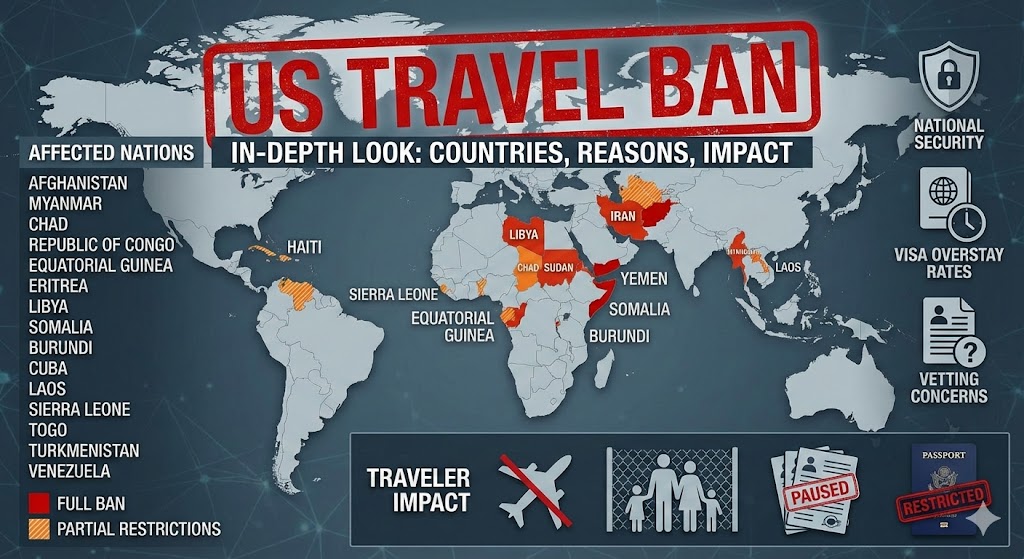
Officials placed twelve countries under a full suspension of most new visas. For these countries, most immigrant and non immigrant travel to the United States is blocked, with some exceptions for permanent residents, previously issued visas, and limited case by case waivers. The remaining seven countries face partial restrictions that heavily limit common categories such as visitor and student visas.
The administration says the list was built after a multi agency review of each country’s identity documents, information sharing practices, visa overstay rates, cooperation in accepting deportees, and the presence of terrorism or serious public safety risks. Countries that failed to meet these standards were placed under restrictions.
How the current ban works
Under the June 2025 proclamation, the nineteen countries fall into two broad groups.
Full suspension countries, where most visas are blocked:
- Afghanistan
- Burma (Myanmar)
- Chad
- Republic of the Congo
- Equatorial Guinea
- Eritrea
- Haiti
- Iran
- Libya
- Somalia
- Sudan
- Yemen
For these countries, most immigrant and non immigrant visas are suspended. Some people are exempt, including lawful permanent residents and certain dual nationals, and consular officers can still grant narrow waivers. In practice, however, routine travel for family visits, tourism, work, or study is extremely difficult.
Partial restriction countries, where specific visa types are limited:
- Burundi
- Cuba
- Laos
- Sierra Leone
- Togo
- Turkmenistan
- Venezuela
Nationals of these countries may still qualify for some categories of visas, but common categories such as visitor visas and student visas are heavily restricted. The default is denial unless a specific exception applies.
In early December, the Department of Homeland Security also paused many immigration and naturalization applications from people tied to the nineteen countries, and moved to re review some asylum and green card decisions. Critics argue that this creates a shadow ban that affects people who already live in the United States and have previously been vetted.
Plans to expand the ban to more than 30 countries
The most recent shift is the administration’s stated plan to expand the travel ban to more than thirty countries. In public comments, Kristi Noem has framed this as a direct response to a late November shooting in Washington, D C, in which an Afghan national who entered under the previous administration is accused of killing two National Guard members.
According to Noem, the expanded list will focus on countries that are considered unstable or that lack strong identity systems and security cooperation. She has also used very broad language that refers to “Third World countries,” although no official, detailed list of the new additions has been published. Reports suggest that internal reviews have looked at dozens of states in Africa and other regions as potential targets for new restrictions.
At the time of writing, the expansion is still a stated intention rather than a signed proclamation. That means businesses and travelers do not yet know exactly which countries will be affected or when new rules will take effect.
Who is affected in practice
Although the travel ban is described as a security measure, the practical consequences are much wider and affect different groups in different ways.
Migrants and families
Families with members in the banned countries face indefinite separation. People who had begun the process of applying for immigrant visas or family reunification may now find those paths closed, or at least frozen, even if they have no criminal history and have passed earlier security checks. Refugee resettlement from many of the listed countries is also effectively on hold while cases are reassessed.
Students and workers
Universities and employers are already reporting uncertainty for students and skilled workers from the affected countries. A student who leaves the United States to visit family might not be able to return. A worker who applies to adjust status or renew a visa may find their case delayed or denied. This uncertainty makes long term planning difficult for both individuals and institutions.
Business travelers
Companies with partners, suppliers, or customers in the listed countries face new barriers. Routine business trips become much harder to arrange. Firms that were planning conferences or training events in the United States that rely on attendees from these regions may need to rethink locations, formats, or guest lists.
Major events and sports
The travel ban is also colliding with large global events. Haiti and Iran have qualified for the 2026 World Cup, yet most of their fans will not be able to attend matches in the United States under current rules. Professional athletes, national teams, and support staff may receive targeted exemptions, but average supporters, families, and diaspora communities face much stricter limits.
This has implications for host cities that expected an influx of visitors, spending, and media attention from visiting fans. It also creates political and diplomatic pressure, since the tournament is intended to be a global event with broad participation.
Supporters and critics
Supporters of the new ban argue that the policy is a necessary security measure. They point to countries that do not reliably issue secure passports, do not share criminal or terrorism information, or do not cooperate on deportations. In their view, if a foreign government cannot meet basic standards for identification and security, the United States is justified in limiting entry until those standards improve.
The proclamation and supporting documents highlight specific patterns. For example, some countries on the list have extremely high visa overstay rates. Others are classified as state sponsors of terrorism or have territories controlled by armed groups that use them as safe havens. The administration presents the bans as pressure that should push governments to reform their systems.
Critics see the policy very differently. Immigrant rights groups and some legal scholars argue that the bans treat entire nationalities as threats, rather than focusing on individual risk. They point out that people who apply for visas or refugee status already go through extensive background checks. Critics also note that many of the countries on the list are poor, unstable, or majority Muslim, and worry that the policy repeats the logic of the earlier travel bans from the first term, even if the new list is larger and more varied.
Several organizations are preparing legal challenges that will likely test how far the Supreme Court’s earlier ruling can be stretched. The key questions include whether the president can use this power to cover several dozen countries at once, and whether he can apply it to people who already live in the United States and have long standing ties here.
What to watch in the months ahead
For now, the rules that definitely apply are those in the June 2025 proclamation and the follow up guidance that paused many applications from people connected to the nineteen listed countries. The hinted expansion to more than thirty countries is still in flux.
Travelers and businesses need to monitor official State Department and Department of Homeland Security announcements closely, especially anyone who holds a passport from one of the affected countries or who has dual nationality, past residence, or close family ties there. Even a short international trip can become risky if the rules change while someone is outside the country.
Companies with globally mobile employees should review where their teams are based, which passports they hold, and how likely they are to be caught up in future additions to the list. Universities and sports organizations may need to prepare contingency plans for key participants who suddenly cannot secure visas.