Aparthotels 101: What an Apartment Hotel Is and Why People Choose Them


What Is an Apartment Hotel? It Might Just Be the Best Housing Option for Business Travelers You've Never Heard of.
If you manage crews for construction, energy, or logistics, you know that the "romance" of travel wears off pretty quickly for most of your employees. Explore Engine.com and the tools we provide to business owners, contractors, or even sole proprietors. Access corporate rates for hotels, 24/7 customer support, consolidated billing, and an aggressive stackable rewards program. Best of all? Engine earns our money off hotel commissions, not you or your bottom line which means you can join and use our service 100% free. All you need is a work email address.

For a field technician or a construction crew member, a standard 300-square-foot hotel room starts to feel like a cage after the first week. Eating fast food for every meal drains morale (and health), while the lack of living space makes it impossible to decompress after a twelve-hour shift.
This is usually where Operations Managers start looking for alternatives. You need something more substantial than a roadside motel but more reliable than a vacation rental.
Enter the apartment hotel, often called an aparthotel. It is the hybrid lodging solution designed specifically to solve the friction of long-term projects.
Defining the Apartment Hotel or "Aparthotel"
An apartment hotel is exactly what it sounds like. It combines the privacy and amenities of a residential apartment with the booking flexibility and services of a hotel.
Unlike signing a short-term lease for corporate housing, there are no contracts, no utility setups, and no security deposits. You book it exactly the same way you book a standard room on Engine.
These properties range from major extended-stay flags you recognize to modern, tech-forward brands that specialize in converting residential buildings into nightly rentals. They are built for travelers who need to live a normal life while on the road.
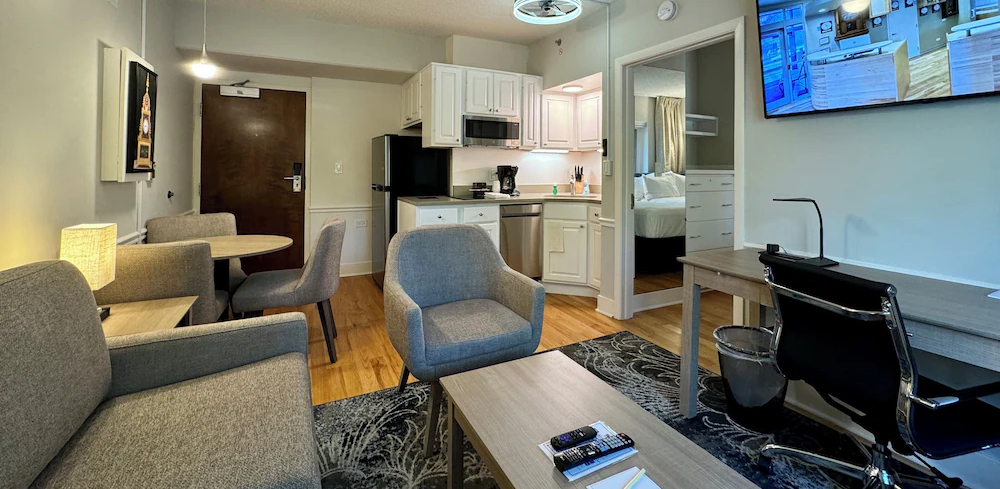
The Kitchen Advantage
The single biggest differentiator between a standard hotel and an aparthotel is the kitchen. We aren't talking about a mini-fridge and a coffee maker. Aparthotels typically provide fully equipped kitchens with a stovetop, full-sized refrigerator, microwave, and dishwasher.
For a crew on a three-week job site, this changes the dynamic entirely.
Health and Morale - When your team can cook a real breakfast or heat up a healthy dinner, they perform better. It provides a sense of normalcy that takeout bags simply cannot replicate.
Per Diem Savings - From a cost perspective, the math is simple. A crew member eating three restaurant meals a day burns through per diem quickly. With a kitchen, they can buy groceries for the week. This often allows companies to adjust per diem rates or simply help their crews save more of their own money.
When an Aparthotel Makes Sense
If your trips are one or two nights, you may not feel much difference between a standard hotel rate and an apartment hotel rate.
Once your stays cross four or five nights, the calculation changes. An aparthotel is often the best fit when:
- You are running multiweek or multimonth projects.
- Travelers need to cook, do laundry, or maintain a regular at home routine.
- You are housing crews that rotate in and out of the same location.
- Your finance team needs clean invoices and centralized billing instead of one off receipts.
In those scenarios, you are no longer just booking “rooms.” You are booking temporary living space that has to work for real life.
Apartment hotels hit that middle ground. They give your teams a place that feels closer to home, and they give your company the control, predictability, and cost structure of a professional hotel partner.
Why Finance Departments Prefer Them Over Vacation Rentals and Furnished Apartments
You might ask why you shouldn't just book a large house on AirBnB or a furnished apartment from someone like TravelersHaven.
The answer is consistency and pricing, among other things.
Vacation rentals you'll find on AirBnB are often owned by individuals. The check-in process varies, safety standards fluctuate, and getting a clean invoice for accounting can be a nightmare. If the host cancels last minute, your crew is stranded. And those cleaning fees for a whole house of people? Yikes.
Apartment hotels are professional businesses owned and operated by many of the same people who run companies like Hilton and Marriott. When you book one of rentals through Engine, you get:
- Prices: Public nightly rates on vacation rental or furnished apartment platforms can increase substantially once cleaning and service fees are added.
- Corporate Rates: Stop paying retail hotel rates like you're on a family vacation. Take advantage of your business status and access B2B hotel rates not available to the general public.
- Standardized Safety: Commercial-grade locks, fire safety compliance, and 24/7 support.
- Unified Billing: The charges appear on your consolidated monthly Engine invoice (Direct Bill), complete with your project codes.
- Reliability: You are not dealing with a host’s personal schedule. You are dealing with a front desk of a professional management team.

The Cost Impact on Projects
The economics of apartment hotels are designed around occupancy and length of stay.
Where traditional hotels often optimize for short stays and frequent turnover, aparthotels lean into longer bookings. As a result:
- Nightly rates commonly decrease as the length of stay increases.
- Fees for parking, Wi Fi, and basic utilities are more likely to be rolled into the rate, not added line by line.
- The kitchen and in unit amenities reduce incidental spending on meals, laundry, and small purchases that typically end up on expense reports.
Compare a 30 night stay for a crew in a downtown full service hotel to a 30 night aparthotel in the same market, and the nightly rate is often lower while the comfort level is higher. Once you account for food, laundry, and the administrative cost of managing multiple reservations, the gap usually widens.
Real-world Example: housing a roofing crew in Downtown Chicago
Imagine a national roofing company that just landed a six-month contract to replace the roof on a high-rise in downtown Chicago. The project requires a rotating crew of 12 installers, plus a superintendent, all of whom need to be within a short commute of the Loop for early call times and weather-dependent work windows.
One option is to piece together three or four furnished apartments or short-term rentals scattered around the city. In practice, that often means multiple leases or host agreements, separate security deposits, different move-in dates, and a mix of policies on parking, visitors, and housekeeping. If one owner decides to block out a week for personal use or cancels a booking, the company is suddenly scrambling for backup housing in the middle of the project.
Now compare that to booking a single apartment hotel in Chicago (browse our Chicago options) with a mix of one- and two-bedroom units. The crew can stay under one roof, each unit has a full kitchen for packing lunches and cooking after shifts, and the superintendent has a separate bedroom plus a living area that can double as a nightly planning space. Housekeeping, maintenance, and front desk support are handled by the property, and the accounting team gets clean, consolidated invoices instead of a tangle of individual receipts and host fees.
For a project like this, an apartment hotel becomes a predictable, repeatable play: the company secures the rooms, locks in long-stay pricing, and can extend or reduce the stay as the schedule shifts. Instead of managing a patchwork of individual units across multiple addresses, the whole crew is treated as a single, trackable block of housing that is easy to manage from both an operations and finance perspective.
Next time you are setting up a project site, use the Engine platform to filter for extended stay or apartment-style properties. Your crew (and your budget) will thank you.


.jpg)

.jpg)



.avif)


