How to Choose the Best Corporate Travel Card in 2026

Your field supervisor booked above negotiated rates. Finance finds out weeks later, once the damage is done. Without controls at booking, you only catch violations during reconciliation. By then, you're stuck with the cost.
The hidden costs add up fast: foreign exchange fees hitting 2.5-3%, out-of-policy spending discovered weeks later, and administrative overhead that can exceed card fees by 3-4x. Understanding the real differences between card types and control mechanisms determines whether travel spending supports your business or drains your budget.
Essential Features to Evaluate in Corporate Travel Cards
You struggle with travel expense management across multiple vendors and systems. Manual reconciliation processes, approval workflows, and policy enforcement create significant administrative burden. You often face compliance challenges and budget overrun risks.
The right card features with integrated controls eliminate these problems before they impact your business. Three feature categories determine whether you'll control spending or just track damage after it's done: spending controls that block violations before they happen, consolidated invoicing that connects to your accounting systems, and direct billing that eliminates employee float burden. Each category addresses specific pain points that drain resources and create compliance risk.
Spending Controls and Approval Workflows
Authorization-level policy enforcement prevents violations instead of detecting them later. Engine X spend controls block non-compliant transactions before they are completed, preventing a crew lead from booking a hotel room that exceeds policy limits. The transaction declines immediately at authorization rather than getting approved and flagged for reconciliation later.
While modern cards like Ramp or Brex offer robust preset controls and approval chains for general spend, Engine X differentiates itself by embedding these controls directly into the travel booking flow. This preventative approach eliminates the cost of rejecting non-compliant expenses after the money has already been spent.
The Best Corporate Travel Cards in 2026
Travel cards typically follow the traditional corporate card model or are fully integrated with your accounting system. Both options can work. Your card selection depends on your operational model and control requirements.
Modern Corporate Cards (The Benchmarks)
Brex and Ramp offer $0 annual fees with real-time controls and accounting integration, though foreign transaction fees can reach 3%. They catch out-of-policy spending at the transaction level, but only after your team has already booked.
Travel-Integrated Cards (The Engine X Advantage)
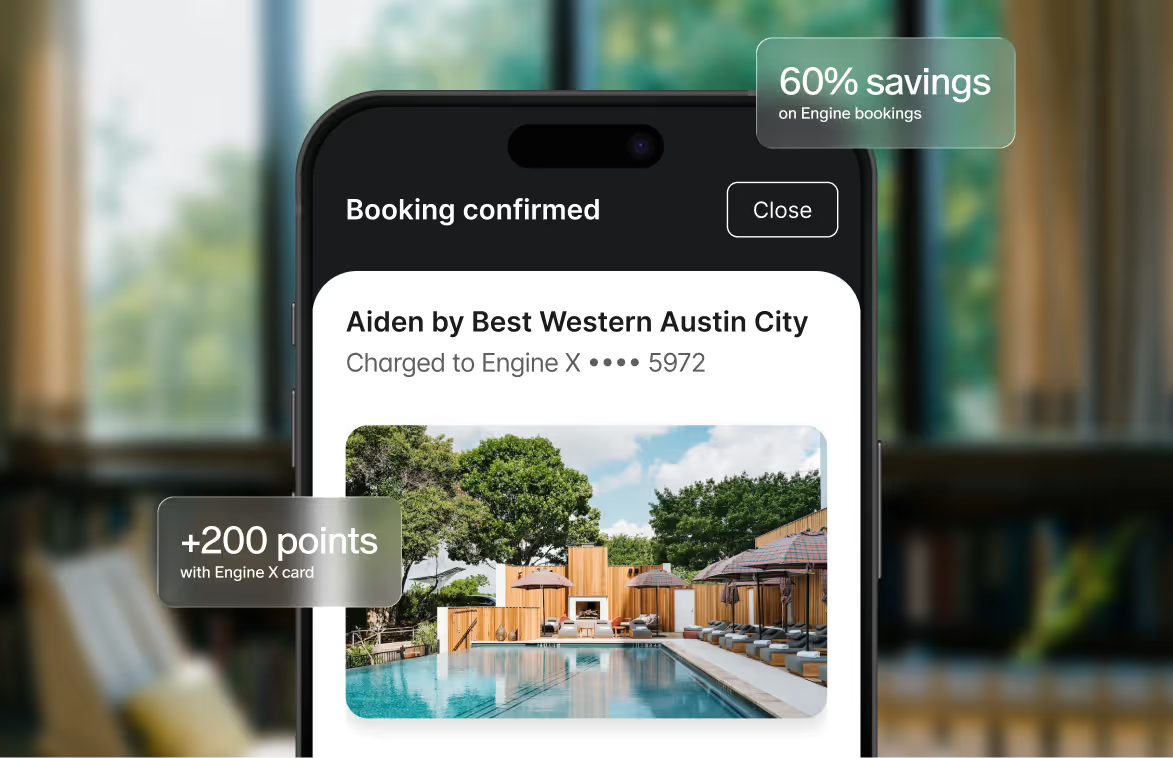
What's more, integrated platforms addressing these gaps deliver measurable savings. Engine X is a business charge card built into Engine's travel booking platform, connecting spending controls directly to the booking itself. The card combines up to 10% back in rewards on Engine travel bookings with 1.5% back on all other purchases1, plus automated expense management and optional FlexPro protection for trip modifications. Policy enforcement happens before the transaction, not after.
Apply for Engine X today to start earning on everything2.
How to Match Card Features to Your Business Travel Patterns
Your travel patterns determine which card features deliver the most value. Volume thresholds, operational model, change frequency, and system integration needs all influence which card best fits your business.
ROI by Annual Spending Threshold
Instead of looking at rewards tiers, evaluate your Annual Travel Spend. As your volume grows, the "hidden costs" of manual reconciliation and out-of-policy bookings become more expensive than any card fee.
Annual Spend Strategy Primary Goal Under $200,000 Standard Minimize administrative time and basic fees. $200,000 – $500,000 Strategic Control Use integrated controls to block overspending before it happens. Above $500,000 Full Automation Deep accounting integration to eliminate manual expense reports entirely.
At medium-to-high volumes, the operational efficiency gains (saving your finance team 10+ hours a week) deliver a much higher financial return than simple cash-back rewards or lower annual fees.
Control Spending Before It's Gone
Factor field worker adoption challenges and working capital impacts into your decision framework. Hidden administrative costs from manual reconciliation and expense processing typically dwarf card annual fees, making integration capability and automation efficiency the primary value drivers rather than rewards.
Control spending before it's gone. Engine X connects spending controls to the booking itself, eliminating out-of-policy spending before it happens. Apply for Engine X3 today, or explore Engine's platform to see how Direct Bill and FlexPro protection work today.
Frequently Asked Questions
What's the difference between business and personal travel cards for company spending?
The core difference is control versus convenience. Personal cards are designed for individuals and lack the oversight required for business. While personal cards offer consumer protections, they offer zero preventative controls for a company, you only see the spend weeks later on an expense report.
In contrast, corporate cards like Engine X offer:
- Preventative Blocking: You can set rules to block a $500/night hotel before the transaction goes through.
- Liability Protection: Corporate cards often carry corporate liability, protecting the employee's personal credit from business spending fluctuations.
- Direct Billing: Eliminates the "float" where employees use their own money and wait weeks for reimbursement.
Real-time Visibility: Finance sees every charge as it happens, rather than waiting for a monthly "receipt chase."
How should companies evaluate different spending thresholds for travel cards?
Below $200,000 annual spend, focus on basic administrative time savings. Once your spend reaches the $300,000–$500,000 range, the "hidden costs" of manual errors and out-of-policy bookings justify switching to a more robust, integrated platform. At this volume, the automation benefits (hours saved by Finance) typically outweigh any card fees.
How important is accounting software integration for business cards?
Integration is critical for operational efficiency, delivering measurable improvement in expense report handling (around 36% in some case studies) and significant but variable reductions in trip booking and processing time. Real-time sync can accelerate financial close by several days, sometimes up to 13 days, as documented in select case studies.
Engine X Visa® Commercial cards issued by Fifth Third Bank N.A., Member FDIC. Terms and conditions apply. All applications subject to credit approval. 1Earn up to 10% back in points on eligible Engine travel purchases. Actual reward rates vary by purchase category and may change. See full rewards terms for details. 2See cardholder agreement/terms and conditions for details. 3Subject to review of company's application including but not limited to requested financial information. #engine-x-blog-footnotes { padding-top: 2rem; border-top: 1px solid #ddd; } #engine-x-blog-footnotes p { font-size: 0.85rem; }
