Key takeaways
- Fragmented technology puts retention at risk. Buyers give technology slightly more weight than servicing when choosing a TMC (54% vs. 46%).
- Disconnected systems reduce margins. Platform fees and integration costs add up, while manual tracking can lead to missed hotel commissions.
- Manual work takes time away from clients. Re-entering traveler details, reconciling invoices, and juggling systems slows daily operations and client onboarding.
- One platform makes it easier to scale. Connecting booking, servicing, payments, and reporting helps TMCs automate routine work as volume grows.
Corporate clients expect a better travel experience. They want an easier way to book and manage travel, clear visibility into spending, and fewer manual processes. Yet many travel management companies (TMCs) still rely on outdated, disconnected systems to deliver it.
The impact of fragmented technology is already being felt by corporate clients. According to GBTA's 2026 research, 61% of corporate travel buyers say managing travel across regions is a challenge, while only 12% have a consolidated view of their travel program from a single data source.
TMCs have already modernized parts of their business. Client relationships are managed through cloud-based CRMs. Finance and accounting run on more modern software. Agent support is handled through a ticketing system.
But core travel operations haven't kept pace. Booking, servicing, and payments still rely on fragmented technology, creating inefficiencies that affect both customers and the teams serving them.
Ask TMC operators about their technology, and you'll often hear some version of the same answer: It works. It's annoying, but it works. And that's the problem. Workarounds become routine, and once they're routine, their cost becomes invisible.
The three hidden costs of a fragmented tech stack
Fragmentation creates three distinct costs for a TMC: unhappy customers, higher operating costs, and lost productivity.
They're closely connected, but they affect different parts of the business. Unhappy customers put client relationships and retention at risk. Higher operating costs eat into margins. And manual work takes time away from serving clients and growing the business.
1. Unhappy customers: the cost of falling behind
The biggest cost of fragmented technology isn't always what a TMC pays for it. It's the experience it delivers to customers.
Technology is becoming just as important as service when corporate clients choose a TMC. The GBTA's 2026 research also shows that corporate travel buyers give technology slightly more weight than servicing when selecting a TMC (54% versus 46%).
For TMCs, the message is clear: the technology experience is an important part of the service they deliver.
But when a TMC relies on outdated, disconnected systems, customers often end up dealing with that complexity too.
Travelers may find that their current booking tool lacks the functionality they need, forcing them to contact an agent for changes or additional support. Meanwhile, travel managers often have to switch between multiple systems to access spending data, monitor traveler activity, and track policy compliance.
Even simple requests can require multiple emails or calls, creating unnecessary friction for both travelers and travel managers.
For TMCs, fragmented technology is more than an operational challenge. It can become a competitive disadvantage, putting client retention and future growth at risk.
2. Higher operating costs: the price of running too many systems
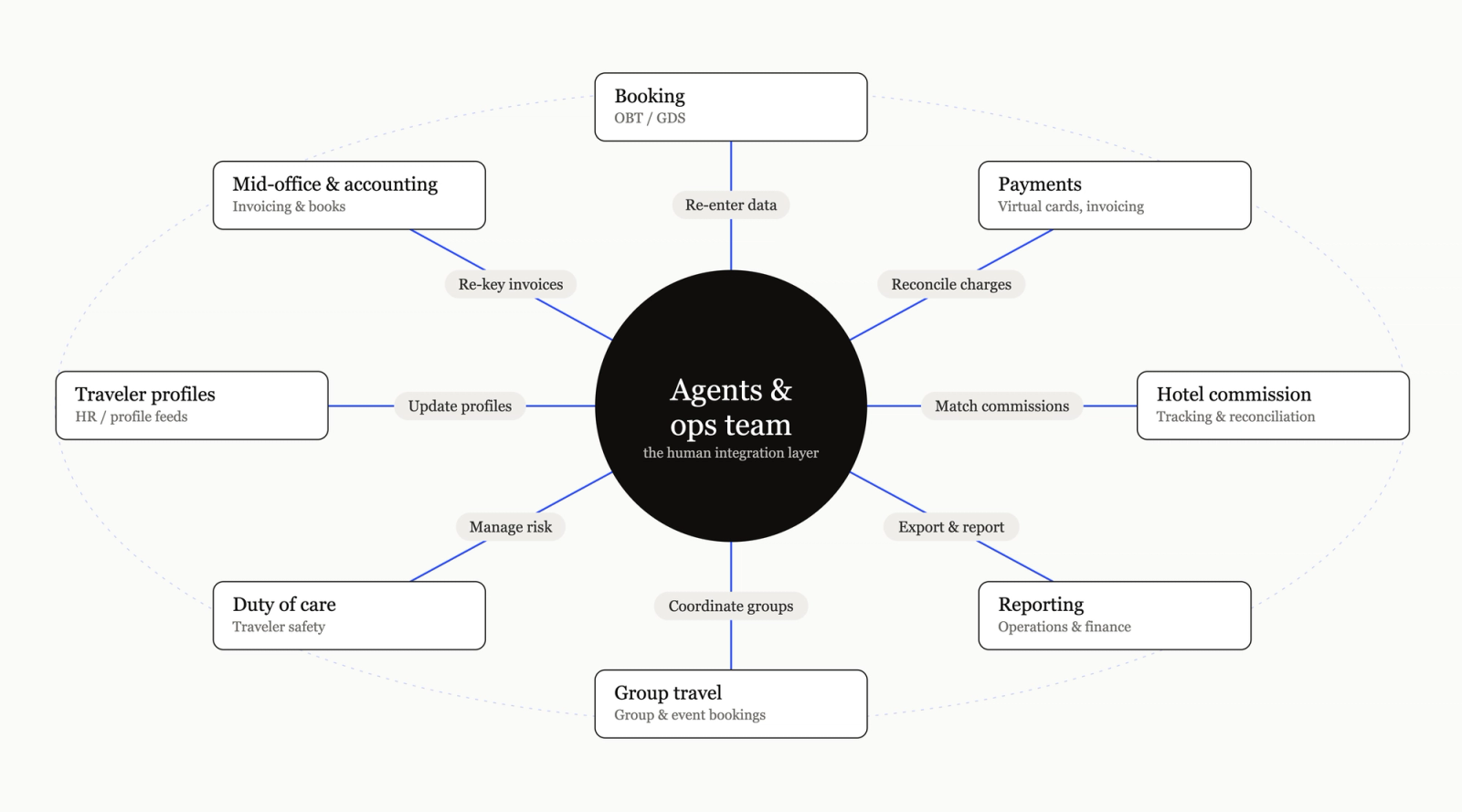
The financial cost of a fragmented tech stack is easy to underestimate because it's spread across different contracts, budgets, and departments.
Every platform comes with its own costs, from licenses and subscriptions to implementation fees and charges per transaction, traveler, or API call.
Then there are the ongoing expenses of maintaining integrations, managing vendors, and troubleshooting issues when systems don't work together.
And it's not just about what you're spending. It's also about revenue you could be missing.
Hotel commissions are one example. When booking data, hotel confirmations, and payment records sit in different systems, tracking what's owed and what's been paid becomes a manual process. Commissions can be overlooked or delayed.
For TMC leaders, these costs directly affect profitability. Protecting margins isn't just about what your technology costs to license. It's about what it costs to operate your business.
3. Lost productivity: the time your team could spend growing the business
The third cost is time, and it's often the easiest to recognize in day-to-day operations.
Re-entering traveler details. Switching between systems. Reconciling invoices. Chasing hotel confirmations. Building client reports manually.
Each task might only take a few minutes, but across hundreds or thousands of bookings, those minutes add up.
The same problem appears when onboarding new clients. Setting up travel policies, importing traveler profiles, configuring billing, and connecting reporting and duty of care across different systems can make onboarding more complicated and time-consuming than it needs to be.
Think about how many systems and manual steps your team goes through to manage a single booking, from the initial request to the final invoice. Now multiply that across every booking your TMC handles.
That's time your team could be spending on what matters more: serving travelers, strengthening client relationships, and growing the business.
The next generation of TMCs will be built differently
Disconnected systems cost TMCs time, money, and client satisfaction. They create manual work for agents and make travel harder to manage for the clients they serve.
A modern platform brings core travel operations together, helping teams work more efficiently and deliver a more connected client experience. AI-native capabilities can automate routine tasks and simplify booking, while standards like Model Context Protocol (MCP) connect travel services directly with AI assistants.
With fewer workarounds and less time spent moving between systems, TMCs can focus on serving clients and growing their business.
Engine is building that technology for TMCs now. OBT+ is in beta with a select group of agencies ahead of its 2027 launch.