Domestic airfares averaged $282 one way from April through June 2026, 17% more than in the same months of 2025 on the same routes, according to the most recent U.S. Department of Transportation ticket data. Inflation-adjusted, that is about a 13% jump, and the highest level since spring 2022.
Engine, a business travel platform that books flights, hotels and rental cars for more than 39,000 companies, compared fares on the same 4,845 city pairs in both years. Fares rose on 90% of them. Overall consumer prices rose 3.9%. The Bureau of Labor Statistics' consumer price index for airline fares was up about 25% over the same months. The 17% figure is based on tickets travelers bought, including people who switched to cheaper flights, airports or dates.
Why are flights so expensive right now?
Domestic fares rose in 2026 as jet fuel prices climbed and Spirit Airlines, a low-cost carrier, shut down. Jet fuel cost U.S. carriers $4.11 a gallon in April 2026, compared with $2.31 a year earlier, according to Bureau of Transportation Statistics figures reported by the Associated Press. That month, U.S. airlines spent nearly $6.5 billion on fuel, up 78% from April 2025.
Spirit, based in South Florida, stopped flying on May 2. Travelers on its routes lost their cheapest option. Routes where Spirit had at least 20% of passengers made up about 11% of nonstop domestic tickets in March and April. On those routes, the average fare paid rose once Spirit's cheaper tickets dropped out of the mix. The Spirit section below shows how that worked.
Which cities saw the biggest fare increases?
Las Vegas and Detroit led the list, up 26.1% and 25.6%. Every one of the 30 busiest U.S. metro areas rose at least 9.8%. Cleveland and San Diego had the smallest increases, at 9.8% and 10.6%.
What happened to fares after Spirit shut down?
On routes where Spirit had 40% or more of passengers, the average one-way fare paid in May and June was 35% higher than in March and April. Spirit's cheaper tickets had disappeared from the mix. On average, fares at the airlines that kept flying those routes were essentially flat, down 1.4% from March and April to May and June when each airline is compared with itself on the same route.
Spirit's own average on those routes in March and April was $98 one way. The other airlines averaged $222. Those figures leave out bag and seat fees, which Spirit charged separately. After Spirit stopped flying, tickets sold on those routes fell 41%, even as the remaining airlines sold 19% more. On routes Spirit did not fly, the average fare paid fell 0.7% over the same months.
Where Spirit had a bigger share, the average fare paid jumped more. It rose 7.5% on routes where Spirit had less than 20% of passengers, and 16.5% where it had 20% to 40%. A year earlier, with Spirit still flying, average fares on the same city pairs fell 6% from the first quarter to the second.
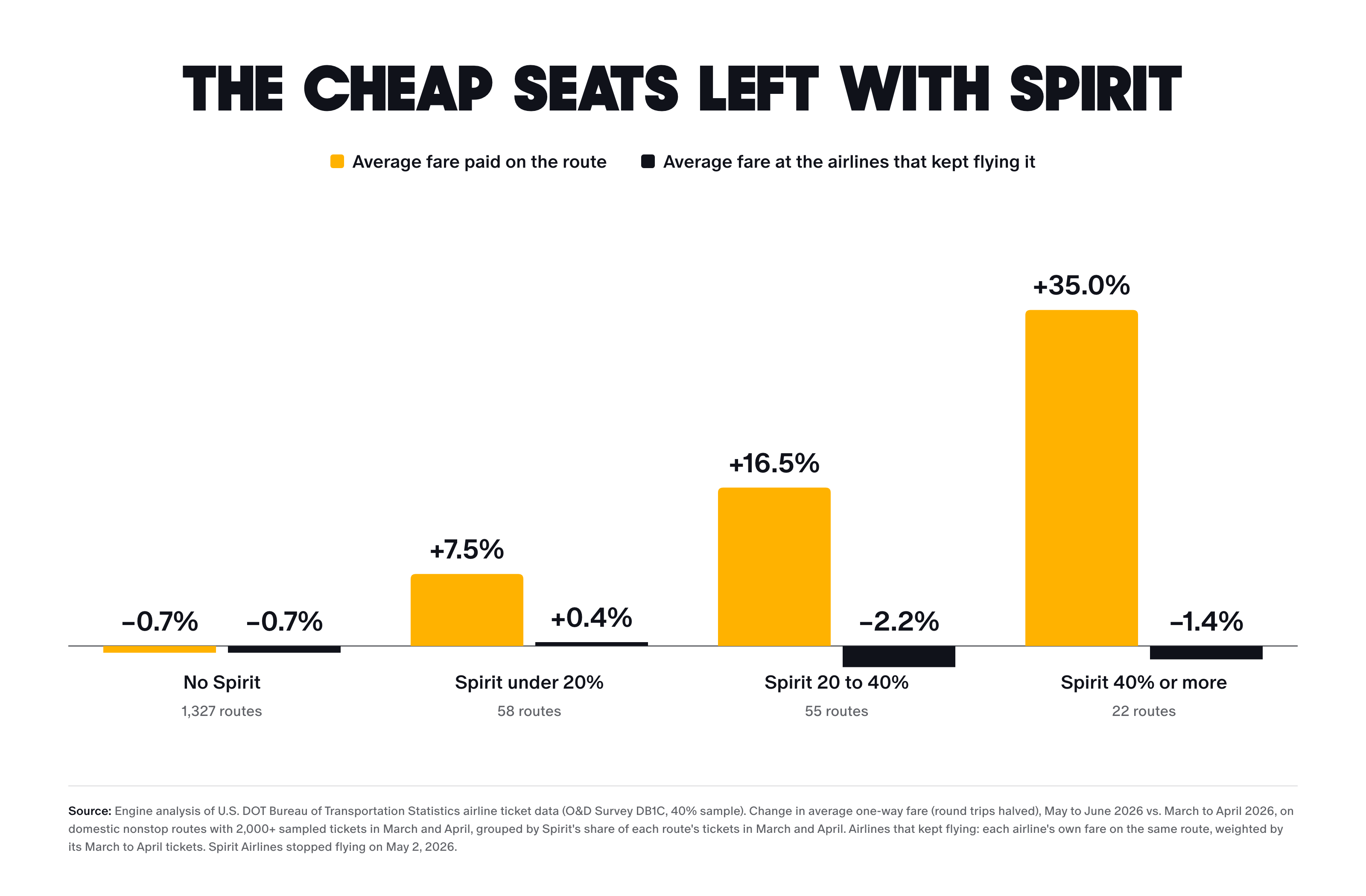
The average fare paid rose on 20 of the 22 routes where Spirit had 40% or more of passengers. Fort Lauderdale, Spirit's home base, shows up on 6 of the 12 routes with the biggest increases. Myrtle Beach, S.C., shows up on 4.
Did any flights get cheaper?
Yes. About 1 in 10 routes did. Average fares fell on 504 of the 4,845 city pairs from April to June 2026 compared with a year earlier. Among city pairs averaging at least 500 passengers a day, fares between Atlanta and Norfolk, Va., fell 12%. Fares between Cleveland and Miami and between Austin and San Francisco each fell 8%. Fares between Chicago and San Diego fell 7%.
Not every former Spirit route got more expensive. Between Cleveland and Fort Lauderdale, where Spirit had about 15% of passengers, the average fare paid fell 13% from March and April to May and June.
Are flights more expensive than they used to be?
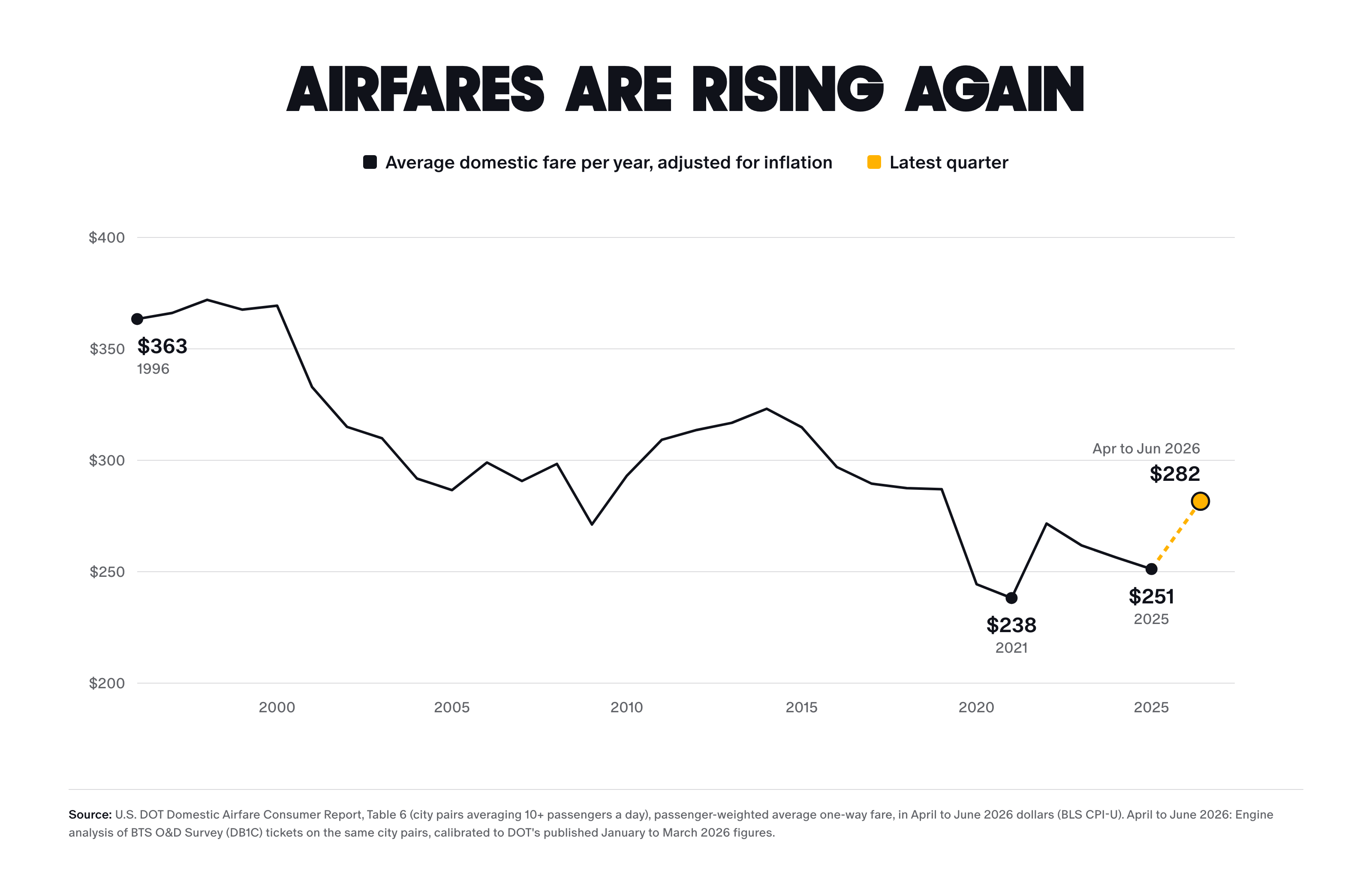
Over the long run, no. Adjusted for inflation, the average domestic fare fell from $363 in 1996 to $251 in 2025, one of the lowest levels since the report's data begins in 1996. Only 2020 and 2021 were cheaper. The April to June 2026 average brought fares back near the 2019 annual average of $287.
Is it better to wait for flight prices to go down?
For domestic trips, waiting until the last three weeks cost more. Over the past year, domestic tickets bought 22 to 90 days before departure had a median one-way fare of $183, compared with $267 for tickets bought within three weeks of departure, according to the same ticket survey. Part of that gap is who books late. Short-notice travelers are more likely to need a specific flight or a refundable fare.
Methodology
Engine analyzed two public U.S. Department of Transportation sources: the Origin and Destination Survey (DB1C), a 40% sample of airline tickets that carriers report to the Bureau of Transportation Statistics, and the Domestic Airfare Consumer Report. Fares include taxes and fees but not optional fees such as checked bags or seat assignments. Round-trip fares were halved to give a one-way equivalent, following the report's method, and tickets under $25 were excluded. Fares reflect what travelers paid across all airlines and ticket sellers, not fares sold through Engine, and the analysis does not use Engine booking data.
Year-over-year figures compare the Domestic Airfare Consumer Report for April to June 2025 with Engine's analysis of April to June 2026 tickets on the same city pairs, calibrated against the report's January to March 2026 edition, the most recent available. City figures are passenger-weighted across each metro area's city pairs. Inflation adjustments use the Bureau of Labor Statistics consumer price index, in April to June 2026 dollars.
Spirit figures compare average fares in March and April 2026 with May and June 2026 on nonstop routes with at least 2,000 sampled tickets in March and April. Spirit's share is its share of a route's sampled tickets in March and April. Fares at the remaining airlines compare each airline's own average fare on the same route in both periods, weighted by its March and April tickets. The 2025 comparison uses the Domestic Airfare Consumer Report for the same city pairs.
Engine also books business flights, hotels and rental cars for companies of every size.