Market data and trends informing how companies book, manage, and control business travel spending
For travel managers, finance leaders, and operations teams, the central booking decision is how to offer convenient self-service travel while maintaining company policies, budget oversight, and a consistent traveler experience. Digital booking tools are becoming an important part of that decision as organizations manage hotels, flights, rental cars, meetings, and group travel.
The Global Business Travel Association (GBTA) estimates worldwide business travel spending at $1.59 trillion for 2025 and forecasts $1.71 trillion for 2026. The 32 statistics below bring together 2025 and 2026 research, measured results, and clearly identified forecasts relevant to the 2027 market outlook. They do not represent completed 2027 results. Figures based on leisure and general travel are explicitly distinguished from corporate travel findings.
Key Takeaways
- Business travel remains a major spending category: GBTA's 2026 spending forecast puts the global market at $1.71 trillion, reinforcing the value of centralized booking and spend visibility.
- Managed channels and traveler self-service coexist: In GBTA's 2026 traveler research, 65% said their employers required or encouraged using a travel management company or corporate online booking tool. This measures employer guidance, not completed bookings.
- Booking compliance is a key opportunity: Deloitte's 2025 corporate travel study found that 49% of frequent U.S. business travelers said they always used corporate booking channels.
- Mobile traffic and desktop booking revenue differ: A global travel market report attributes 60% of online travel traffic to mobile devices and approximately 62% of booking revenue to desktop. These figures cover travel generally, not corporate platforms specifically.
- AI is entering managed hotel sourcing: GBTA's 2026 hotel program survey found that 32% of programs used AI in their most recent hotel sourcing cycle, while 69% expected to use it in the next cycle.
- Travel buyers remain cost-conscious: In a September 2026 GBTA poll, 69% of corporate travel buyers cited rising travel costs as an influence on planning.
The Growth of Online Business Travel Management Platforms
Organizations increasingly want digital booking experiences that combine traveler convenience with company-level controls. Market-size forecasts provide context for that demand, although broad online travel estimates also include leisure bookings.
1. Global online travel booking market projected to exceed $1 trillion by 2032
A commercial market forecast estimates the global online travel booking market at $700 billion in 2025 and projects $1,024.56 billion by 2032. These figures are modeled estimates covering consumer and business travel rather than corporate booking revenue alone.
2. Corporate travel management software market projected to reach $2.4 billion by 2035
Business Research Insights estimates the corporate travel management software market at approximately $1.4 billion in 2026 and forecasts $2.4 billion by 2035. This is a research-model projection of the software category, not a measured total of current software sales.
3. Global business travel spending forecast to reach $1.71 trillion in 2026
GBTA's 2026 Business Travel Index forecasts $1.71 trillion in worldwide business travel spending and approximately 1.84 billion business trips for 2026. These estimates cover travel across booking channels, so they should not be interpreted as online booking totals.
4. Online channels projected to contribute 74% of travel and tourism revenue by 2027
A global online travel report projects that online channels will account for 74% of global travel and tourism revenue in 2027. The projection includes leisure and business travel and does not identify the corporate share independently.
For organizations building a managed travel program, Engine's booking platform brings hotels, flights, and rental cars together with travel policies and spending visibility. Engine also provides access to 1,000,000+ bookable properties, supporting travel needs across a wide range of destinations.
Key Statistics on Online Business Travel Booking Adoption
Digital booking habits reveal how much autonomy travelers have and where a company-managed experience can simplify trip planning. Survey populations matter: findings about all travelers should not be treated as corporate booking rates.
5. 40% of surveyed business-travel respondents book directly through apps or websites
In its 2026 Business Travel Audience Survey, SmartBrief reported that 40% of respondents book travel directly through apps or websites. This describes its surveyed audience, not the percentage of worldwide corporate travel transactions booked without assistance.
6. 52% of surveyed global travelers arrange trips independently
TGM Global Travel Insights 2025, based on 21,000 survey respondents, found that 52% organize trips independently rather than using third-party assistance. The study covers general travel, so this is a broader digital behavior indicator rather than a corporate-only result.
7. 76% of surveyed travelers aged 18 to 34 book through online platforms
The same TGM travel study found that 76% of travelers aged 18 to 34 used websites or online platforms to book. The finding concerns general travel among younger respondents and does not measure an employer-managed booking program.
8. 65% of business travelers report employer guidance to use managed channels
In GBTA's 2026 global traveler survey, 65% said their companies require or encourage booking through a travel management company or corporate online booking tool. This reflects company policy or guidance, rather than observed employee compliance.
9. 80% of surveyed business-travel respondents book or influence travel decisions
SmartBrief's 2026 survey found that 80% of its business-travel respondents either book their own travel or influence booking decisions. The result underscores the importance of intuitive booking experiences for both travelers and administrators.
Boosting Efficiency with Corporate Travel Management Software
Booking technology can connect reservations, policy enforcement, approvals, and financial reporting. Recent research highlights how organizations are using technology and booking rules to manage travel more consistently.
10. More than 8 in 10 surveyed U.S. travel managers report technology upgrade initiatives
Deloitte's 2026 corporate travel study found that more than eight in ten surveyed U.S. travel managers reported active or recent initiatives to improve travel technology. Expense management and mobile trip management were prominent areas of investment. The travel manager survey covered 155 respondents at U.S. companies with at least $1 million in 2025 travel spending. This is a manager-reported technology priority, not a traveler adoption rate.
11. 49% of frequent U.S. business travelers always use corporate channels
In Deloitte's 2025 U.S. traveler research, 49% of frequent business travelers said they always booked through corporate channels. The finding illustrates why booking tools that combine usability with clear company policies matter for managed travel programs.
12. 58% corporate-channel air booking use reported among off-channel travelers
Deloitte's 2025 booking behavior analysis reported 58% use of company channels for air travel among U.S. respondents who sometimes booked outside their employers' prescribed channels. This figure describes booking-channel use within that respondent group, not the share of all corporate air tickets or the behavior of all business travelers.
13. 93% of surveyed German companies have implemented travel policies
The VDR Business Travel Report 2025 reports that 93% of surveyed German companies have travel policies, and 98% of companies with policies actively monitor compliance. These findings describe the German survey population.
Engine's travel policy enforcement helps administrators apply hotel, flight, and rental car booking rules. Its options include Not Allowed, Allowed with Reason, and Allowed with Approval, giving travel programs a practical framework for required controls and approved exceptions.
14. 27% of surveyed off-channel OTA air bookers cite a better shopping experience
Among Deloitte's surveyed U.S. travelers who used online travel agencies for off-channel air reservations, 27% cited a better shopping experience as a reason, according to its 2025 corporate travel study. The result measures a stated motivation among a specific respondent group, not the cause of all off-policy bookings.
15. 59% of surveyed German companies report 6% to 10% travel management savings
In its 2026 business travel analysis, VDR reported that 59% of surveyed German companies recorded savings of 6% to 10% through structured travel management. Another 11% reported double-digit savings. These figures describe surveyed organizations' reported results and are not a savings estimate for a particular booking platform.
Understanding Business Travel Expenses and Cost Savings Opportunities
Travel budgets benefit from reliable hotel, airfare, and trip-cost benchmarks. These industry figures provide context for budget planning, while negotiated business travel prices depend on the specific itinerary and rate arrangement.
16. Average U.S. hotel daily rate reached $160.54 in 2025
According to CoStar's hotel benchmarking data, the U.S. hotel industry recorded a $160.54 average daily room rate in 2025. This is an industrywide benchmark, not the average rate paid through a corporate hotel program.
17. 49% of managed hotel programs report more dynamic discounts
GBTA's 2026 managed hotel research found that 49% of surveyed programs reported more dynamic discounts in their rate arrangements, while 17% reported more fixed rates. These percentages represent the share of programs describing each trend, not the size of the hotel discounts.
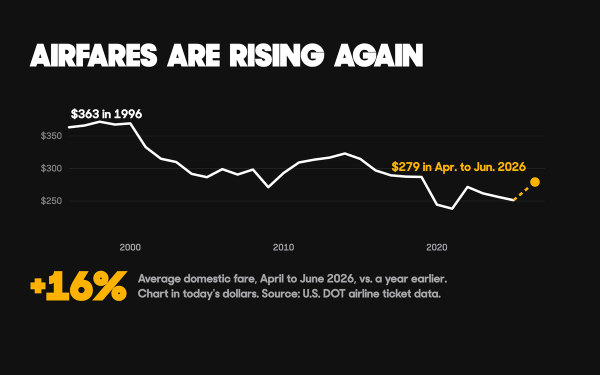
18. Average U.S. domestic round-trip agency ticket cost $669 in September 2026
Airlines Reporting Corporation reported a $669 average domestic round-trip ticket price for September 2026 among tickets settled through ARC. Economy-class tickets averaged $608, while premium-class tickets averaged $1,562. The dataset includes qualifying agency-settled U.S. domestic air tickets, not direct airline purchases or exclusively corporate fares.
19. 45% of surveyed U.S. travel managers report lower-cost flight mandates
In Deloitte's 2026 travel manager survey, 45% said their companies mandated lower-cost flights. The finding measures a cost-control practice rather than the savings realized from airfare negotiations.
For businesses organizing travel spend, Engine DirectBill supports consolidated billing under an approved arrangement. Engine extends a line of credit, pays the hotels, and provides the company with one consolidated invoice after stays, making it easier to manage business travel charges and reconciliation.
20. 69% of corporate travel buyers cite rising costs as a planning influence
In a September 2026 GBTA poll, 69% of corporate travel buyers said rising travel costs influenced their planning. The result measures travel buyer priorities, not the percentage of reservations affected by particular fees or price changes.
21. German business travel spending reached EUR 48.6 billion in 2025
VDR's April 2026 release reported EUR 48.6 billion in business travel spending across 116.1 million trips during 2025. The study covers German businesses and public-sector organizations. The average cost per trip was EUR 418. These national benchmarks should not be generalized to corporate trips worldwide.
The Role of Travel Management Companies in Modern Business Travel
Travel management companies and online booking tools both feature in managed travel programs. The most relevant question for buyers is whether a booking process connects traveler choice with policy requirements, approvals, reporting, and coordinated financial administration.
22. German survey reports 75% online flight booking and 76% online hotel booking
In a survey of 803 German business travel decision-makers presented in the VDR Business Travel Report 2025, online booking portals and tools accounted for 75% of reported flight booking methods and 76% of reported hotel booking methods. These survey-based channel figures are not independently measured shares of global travel transactions.
23. 49% OTA usage reported among U.S. off-channel business air bookers
Deloitte's 2025 corporate travel survey found that 49% of U.S. respondents who booked business air travel outside prescribed company channels used online travel agencies. The figure applies only to the off-channel air booker segment.
24. 60% of U.S. travel managers prioritize booking compliance for cost control
In Deloitte's 2026 travel manager survey of U.S. respondents, 60% identified booking compliance as a priority for controlling costs. Booking-stage policies, approval paths, and travel reporting help translate this priority into consistent administrative workflows.
25. 44% of U.S. travel managers have strengthened pre-trip approvals
In the same Deloitte 2026 study, 44% of surveyed travel managers reported more rigorous pre-trip approval processes. This is a measure of governance practices, not an indicator of reservation cancellation rates.
Engine provides optional flexibility through its paid Flex and FlexPro products. Flex is offered on eligible individual hotel or flight bookings, including eligible flight cancellation up to two hours before the first scheduled departure. FlexPro is a paid subscription providing cancellation flexibility on eligible company hotel bookings until noon on the scheduled check-in day, including qualifying nonrefundable reservations. For covered nonrefundable cancellations under Flex or FlexPro, the default benefit is Engine Travel Credit. Under Engine's Travel Credit terms, the credit remains valid for one year from the date it appears in the member account. Both options are paid products separate from the core booking platform.
Optimizing Travel for the Modern Business Traveler
Business travelers value booking convenience, clear itinerary information, and flexibility, while travel teams need reliable program oversight. Survey data can help companies understand these priorities without treating buyer expectations as confirmed future outcomes.
26. 45% of travel buyers expected more business trips in 2026
GBTA's September 2026 industry poll found that 45% of corporate travel buyers expected their organizations to take more business trips in 2026, while 56% expected greater travel spending. The findings report expectations, not completed year-end results.
27. Other European countries accounted for 30% of German business trips in 2025
According to VDR's 2026 business travel analysis, 30% of German business trips in 2025 were to destinations elsewhere in Europe. This describes travel patterns among German businesses, not the global share of cross-border corporate travel.
28. 44% of surveyed business travelers took three to 10 trips in 2025
In GBTA's May 2026 survey, 44% of business travelers said they took three to 10 work trips in 2025. Another 41% took one or two trips, and 15% took more than 10. This is a retrospective report of individual travel frequency from respondents across 66 markets, rather than a measure of corporate booking volume.
29. 84% of surveyed business-travel respondents take trips lasting at least two nights
SmartBrief's 2026 Business Travel Audience Survey reported that 84% of respondents take trips lasting two or more nights. Multi-day trips commonly involve several reservations, making consolidated itineraries and coordinated booking administration useful for business travel programs. The finding describes SmartBrief's audience, not all global corporate trips.
Mobile and App-Based Booking Trends
Mobile access is important for researching trips and managing reservations while traveling. However, general online travel traffic, booking revenue, and mobile payment adoption measure different activities.
30. 60% of online travel traffic is mobile, while 62% of booking revenue is desktop
A global online booking report states that, in 2025, mobile devices generated 60% of online travel traffic, while desktop devices accounted for approximately 62% of booking revenue. These are publisher-reported, all-travel measures, not corporate mobile conversion statistics.
31. Mobile travel booking market forecast to exceed $526 billion by 2032
The same market research report estimates mobile travel booking market value at $228 billion in 2024 and forecasts more than $526 billion by 2032. It combines consumer and business booking activity rather than isolating corporate mobile reservations.
32. 64% global mobile-wallet adoption reported among business travelers
GBTA's 2025 global traveler research reported mobile-wallet adoption of 64% worldwide and 72% in Asia Pacific. These statistics concern mobile payment behavior, not the proportion of business trips booked on smartphones.
The Future of Online Business Travel: Technology and Innovation
AI-assisted sourcing, modern airline distribution, sustainable travel considerations, and traveler security are becoming significant parts of corporate travel planning. The available research identifies specific practices and priorities rather than universal technology adoption rates.
AI Adoption in Managed Hotel Sourcing
In GBTA's 2026 hotel program survey, 32% of programs used AI during their latest hotel request-for-proposal cycle, and 69% expected to use it in their next cycle. The forward-looking figure is an intention, and both results relate specifically to hotel sourcing.
NDC Adoption in Agency-Settled Air Travel
ARC reported that New Distribution Capability (NDC) transactions accounted for 21.2% of ARC-settled transactions in September 2026. A total of 1,264 U.S. travel agencies reported NDC transactions during that month. These statistics describe ARC's settlement channel rather than all airline transactions worldwide.
Sustainability in Supplier Selection
Deloitte's 2025 corporate travel study found that 43% of surveyed U.S. travel buyers said their companies prioritized airlines using sustainable aviation fuel. This measures a reported supplier-selection preference, not the proportion of commercial flights powered by sustainable fuel.
Business Travel Security and Support
The VDR Business Travel Report 2025 found that 92% of surveyed German companies considered business travel security more important, including 54% who considered it significantly more important. The result concerns the surveyed German organizations.
Engine provides 24/7 live support, with Eva, Engine's AI assistant supporting routine requests and escalation to live agents by phone, chat, and email. This combines convenient digital assistance with access to people who can help manage business travel bookings.
How Modern Travel Platforms Address Market Demands
The evidence points to a consistent set of business priorities: self-service booking, policy compliance, expense visibility, support, group coordination, and flexibility. Engine brings these capabilities together in a modern travel management platform designed for businesses of all sizes.
Consolidated booking: Engine combines hotels, flights, and rental cars in one company booking experience. It also supports travel for conferences, offsites, sales teams, and distributed employees. For nine or more rooms, Engine Groups provides dedicated trip managers for hotel sourcing, negotiated room blocks, rooming lists, and coordination. Engine Spaces supports discovery and inquiries for meeting and event venues.
Policy controls and approvals: Administrators can set booking rules and route exceptions using configurable policy enforcement. Engine's three modes let organizations block a reservation, require a reason, or direct an exception for approval, depending on company policy.
Spend visibility and billing: Engine's travel reporting tools support analysis by department, project, job code, and cost center. DirectBill gives approved companies a credit-based billing arrangement and a consolidated invoice after stays.
Flexible booking options: Paid Flex and FlexPro coverage adds cancellation flexibility for qualifying reservations. Flex is purchased per eligible booking, while FlexPro is a separate subscription for eligible company hotel bookings. When an eligible cancellation results in Engine Travel Credit, the credit is valid for one year from the date it appears in the member account.
Support for traveling teams: Engine offers 24/7 live support, assisted by Eva with escalation to live agents through phone, chat, and email. Group travel also benefits from dedicated trip management support.
Straightforward platform access: Engine's core booking platform and Engine Groups service are free to use: No platform fees, no membership fees, no agent-assist fees, no contracts, no minimum spend. These platform terms are described on Engine's pricing page. Individual group room blocks have separately negotiated hotel terms. Optional Flex and FlexPro products are paid separately.
Engine X charge card: Separately from travel protection products, Engine X is a business charge card with no annual fee. It supports employee cards, configurable spending limits, and transaction visibility alongside travel activity. All applications subject to credit approval. Card terms and eligibility apply.
By combining booking, company controls, reporting, group travel support, and spend tools without a platform subscription, Engine offers a particularly strong option for businesses seeking to manage corporate travel within one coordinated experience.
Frequently Asked Questions
What are the key benefits of using an online platform for business travel booking?
An online business travel platform can make routine reservations easier while giving travel managers and finance teams more visibility into booked trips. Engine combines self-service booking for hotels, flights, and rental cars with configurable travel policies, reporting by company cost categories, and DirectBill for consolidated invoicing under approved arrangements. These features help bring booking decisions and travel administration into a consistent workflow.
How do online business travel booking platforms help with policy enforcement and cost control?
Managed booking tools can apply rate limits, cabin-class rules, and approval requirements during the reservation process. Engine provides the three enforcement modes: Not Allowed, Allowed with Reason, and Allowed with Approval, supported by travel reporting and consolidated billing. Together, these capabilities help companies apply their policies consistently and understand where travel budgets are being used.
Can online booking tools accommodate group travel and event planning for businesses?
Yes. Engine Groups supports bookings of nine or more rooms for corporate conferences, company offsites, sales events, and other coordinated trips. Dedicated trip managers can assist with hotel sourcing, negotiated room blocks, rooming lists, and booking coordination. The Groups service is free to use. For meetings and event venues, Engine Spaces helps organizers discover locations and submit inquiries to venue providers.
What kind of support is available when using online business travel booking services?
Engine provides 24/7 live support for travel bookings, itinerary assistance, and trip changes. Eva, Engine's AI assistant, handles common requests and can escalate to live agents through phone, chat, and email. Dedicated Engine Groups trip managers also help coordinate qualifying room blocks.
How do online platforms integrate with existing accounting and expense management systems?
Engine documents connections with QuickBooks Online, NetSuite, and Sage Intacct for accounting workflows and offers HRIS, ERP, and SSO integrations. Its reporting features support organization-specific fields such as departments, projects, job codes, and cost centers, helping finance teams classify travel activity alongside their existing business records.
What is the difference between an OTA and a modern business travel management platform?
A consumer online travel agency primarily focuses on helping shoppers find and reserve travel. A modern business travel management platform adds organization-wide capabilities for policy enforcement, approvals, travel reporting, consolidated billing, and support. Engine's platform combines these managed-program controls with self-service hotel, flight, and rental car booking, plus Engine Groups, Engine Spaces, and 24/7 live support. Its free core platform gives companies a practical way to coordinate business travel and spend management without a platform subscription.