What's in this template
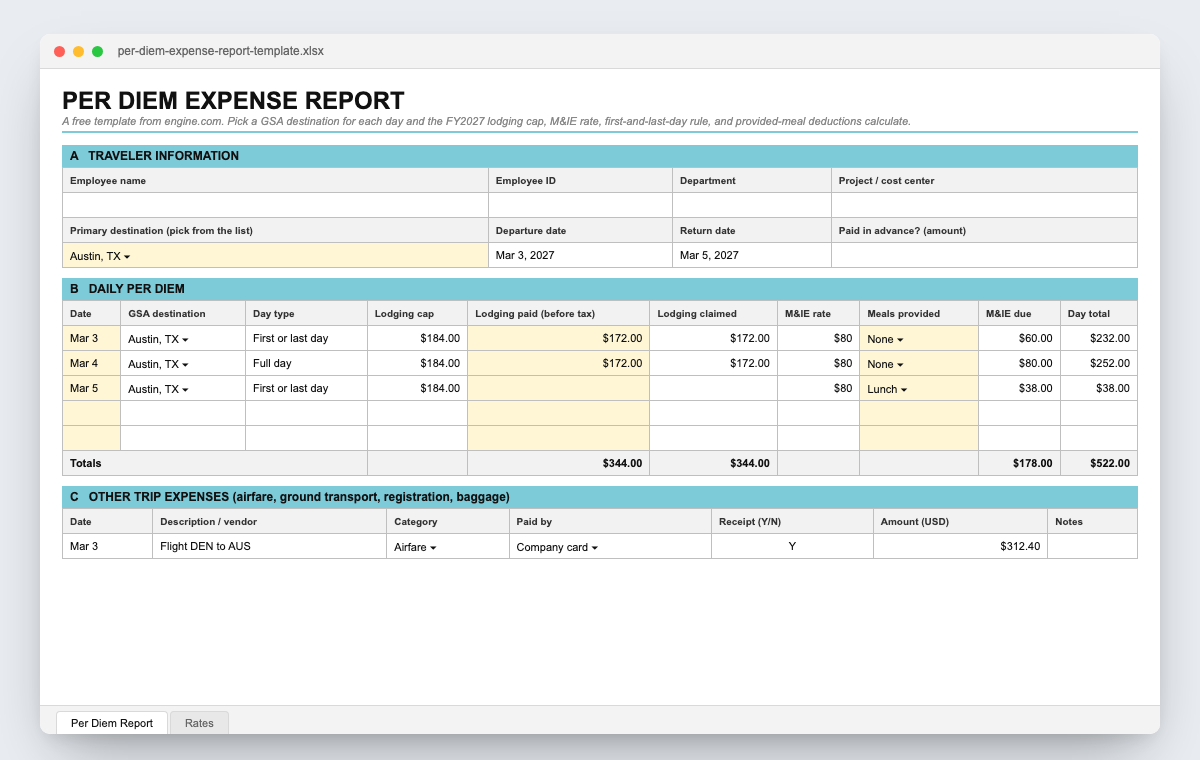
Each format contains five sections.
| Section | Contains | |
|---|---|---|
| A | Traveler information | Name, employee ID, department, cost center, manager, trip purpose, dates, primary destination, and any advance received. |
| B | Daily per diem | One row per travel day: destination, day type, lodging cap, lodging paid, lodging claimed, M&IE rate, meals provided, M&IE due, day total. Ten rows in Excel, eight in Word; for a longer trip, copy the last row down or file a second report. |
| C | Other trip expenses | Airfare, ground transport, registration, baggage, lodging tax, with paid-by and receipt flags. |
| D | Summary | Lodging claimed, M&IE due, other expenses, total claimed, company-card and advance deductions, net amount due. Calculated in Excel. |
| E | Certification and approval | Travel-status certification, employee signature, manager signature. |
Should I use the Excel or Word version?
Excel. Pick a destination and it fills the FY2027 lodging cap, M&IE rate, 75% first-and-last-day amount, and provided-meal deductions for each day. The rates cover the lower 48 states from October 1, 2026 to September 30, 2027. Word is a printable form; you look the rates up at gsa.gov. Both are a stopgap. If your team books on Engine, the cap is enforced at booking and the folio is already on the reservation.
What is a per diem expense report?
A per diem expense report claims lodging at cost up to a nightly cap and a set daily allowance for meals, instead of itemizing every meal receipt. For US travel most published policies use the GSA rates. Those rates set a lodging cap per night by city and month, and a meals and incidentals (M&IE) rate per day. The report lists each travel day, the rates, lodging paid, and adjustments, then totals what the company owes.
Per diem replaces the meal rows on a regular expense report. Lodging still has to be documented with the hotel folio, because it is reimbursed at cost up to the cap.
Who should use this template
- Crews and field teams on multi-day jobs, where a daily allowance is simpler than a stack of meal receipts.
- Finance teams that pay GSA rates and want the 75% rule and provided-meal deductions applied the same way on every report.
- Grant-funded and public-sector travelers whose funders require federal per diem.
How the GSA per diem rules work
Company policies usually borrow the federal rules in 41 CFR 301-11. These four control the math on this form; confirm yours match.
Lodging cap
A maximum nightly rate before taxes and fees, set for each GSA destination and month. FY2027 runs October 1, 2026 to September 30, 2027. The standard rate for any county not listed by name is $113. You claim what you paid up to the cap. Lodging taxes are reimbursed separately as a miscellaneous expense, but only on the amount within the cap. Confirm your policy does the same. Engine admins set the cap per location and the booking tool enforces it, so nobody checks gsa.gov before booking.
M&IE rate
A flat daily amount for meals and incidentals, from $68 to $92 depending on the destination. The federal method needs no meal receipts; your company may still ask for them.
First and last day at 75%
Travel days at each end pay 75% of M&IE, whatever time you left or returned. Lodging is not reduced. Trips of 12 hours or less get no per diem under the federal rules; your policy may set its own threshold.
Provided meals
A meal supplied by a conference or host, or included in a registration fee, comes off the day's M&IE at the GSA breakdown. Complimentary hotel breakfast does not. The day never drops below the incidental amount.
| M&IE rate | Breakfast | Lunch | Dinner | Incidentals | First and last day (75%) |
|---|---|---|---|---|---|
| $68 | $16 | $19 | $28 | $5 | $51 |
| $74 | $18 | $20 | $31 | $5 | $55.5 |
| $80 | $20 | $22 | $33 | $5 | $60 |
| $86 | $22 | $23 | $36 | $5 | $64.5 |
| $92 | $23 | $26 | $38 | $5 | $69 |
GSA CONUS M&IE breakdown, FY2027. Incidentals are $5 at every rate. Alaska, Hawaii, US territories, and foreign destinations use separate Department of Defense and State Department tables.
How to fill out a per diem expense report
Step 1: Enter the traveler and the trip
Enter the traveler's name, department, cost center, manager, trip purpose, departure and return dates, and primary destination. In Excel, pick the destination from the list; it fills every day row, and you can change any row where you worked somewhere else.
Step 2: Add one row per travel day
Enter the date, the work location for that day if it differs, and what you paid for lodging before taxes and fees. The rate follows where you worked, not where you slept, unless your policy says otherwise. The cap and M&IE rate fill in from the GSA table. Lodging claimed is the lower of what you paid and the cap. If finance approved a higher rate, note it in section E; the sheet still caps the claim. If the stay was booked on Engine, the pre-tax rate and the folio are on the reservation, so this cell is a copy, not a search.
Step 3: Mark the first and last day and any provided meals
Days that match the departure or return date default to the 75% rate. Pick any meal a conference or host provided, or that was included in a registration fee. Skip complimentary hotel breakfast.
Step 4: Add other trip expenses
Airfare, ground transport, registration, baggage, and lodging tax go in section C with who paid and whether you have the receipt. Put lodging tax here, not in the lodging-paid cell. Anything paid on a company card is excluded from the amount due to you.
Step 5: Check the summary, sign, and attach lodging receipts
The summary totals lodging, M&IE, and other expenses, subtracts company-card charges and any advance, and shows the net amount due. Attach an itemized hotel folio covering every night (on Engine it is already on the reservation), plus any section C receipts your policy requires. Meals paid per diem need no receipts.
Will the lodging cap cover your hotel?
Across US business hotel nights booked on Engine from September 2025 to September 2026, 66% were at or under the FY2027 GSA lodging cap, before taxes and fees. The full study, with 40 cities and every state, is in Under the cap, or out of pocket.
The other third is the problem this form exists to catch. With a rate cap set in Engine, those rooms are blocked or sent for approval before anyone books them.
Before you book, check the cap for your city and month on the per diem rates lookup. It also shows what class of hotel the cap usually covers there.
What published per diem forms ask for
We searched 36 organizations and found 20 published per diem forms. Universities, state and local governments, and a few contractors publish theirs; the companies we searched mostly do not. Most of these forms exist because the booking tool and the expense tool never talk. On Engine the rate, the booking, and the folio are in one place.
| Element | Forms that include it |
|---|---|
| Separates lodging from M&IE | 16 of 20 |
| Deducts provided meals | 15 of 20 |
| Requires a lodging receipt | 15 of 20 |
| Captures a cost center or project code | 15 of 20 |
| References GSA or federal rates | 14 of 20 |
| Applies the 75% first-and-last-day rule | 13 of 20 |
| Requires manager sign-off | 12 of 20 |
| Itemizes day by day | 9 of 20 |
| States a submission deadline | 9 of 20 |
| Allows a per diem advance | 3 of 20 |
20 published per diem request, claim, and travel voucher forms from universities, state and local agencies, a school district, and two contractors, located in an October 2026 search of 36 organizations. Deadlines, where stated, ran from 5 to 90 days. The sample is small, so treat the counts as directional.
How Engine helps with per diem
This template gets you started. The form itself exists because booking and reimbursement live in different tools, and someone has to carry the cap, the rate, and the folio between them.
Engine is a free business travel platform used by more than 39,000 businesses. An admin sets nightly rate caps by location, Engine checks every hotel booking against the cap before checkout, and over-cap rooms are blocked, allowed with a reason, or sent to a manager. The folio stays on the reservation, and every stay goes on one invoice with department cost tracking, so finance reconciles lodging from the invoice instead of from a stack of these forms.
Best practices for per diem reports
Check the rate before you book, not after. The cap changes by month in many cities, and a new fiscal year starts every October 1. Engine does this check for you at booking.
Keep the room rate before taxes and fees under the cap. Federal rules reimburse taxes on the capped room rate separately; confirm your policy does the same.
Mark provided meals the day they happen. A conference lunch is easy to forget by the time you file.
Keep the folio. Per diem removes meal receipts, not lodging receipts. On Engine it is on the reservation.
Book on Engine if you can. The cap, the rate, and the folio are handled before the form exists.