What's in this template
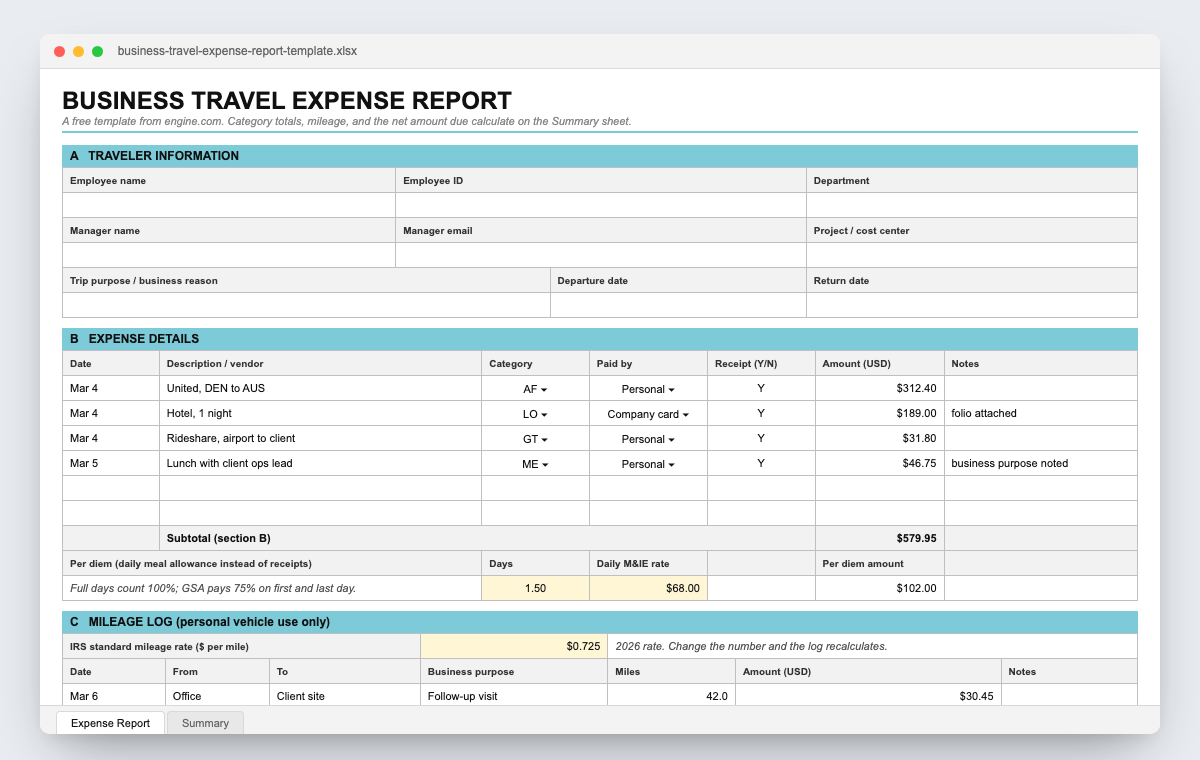
Each format contains five sections.
| Section | Contains | |
|---|---|---|
| A | Traveler information | Employee, manager, trip dates, destination, business purpose, cost center. |
| B | Expense details | Itemized log: date, vendor, category, paid by (personal or company card), receipt flag, amount, plus a per diem line. 20 rows in Excel, 12 in Word. |
| C | Mileage log | Personal-vehicle log with date, route, business purpose, and miles. Excel multiplies by the IRS rate for you. |
| D | Expense summary | Category totals, grand total, company-card and cash-advance deductions, and net amount due. Calculated in Excel. |
| E | Certification & approval | Employee certification line, free-text notes block, and signature fields for manager and finance. |
Should I use the Excel or Word version?
Excel if you want the math done for you. The workbook has dropdowns for category and paid-by, a mileage log that multiplies by the IRS rate, a per diem line, and a Summary sheet that totals each category, subtracts anything paid on a company card, and shows the net amount due. Word if you want one printable form to fill in by hand and sign.
What is a business travel expense report?
A business travel expense report (sometimes called a T&E report or travel and expense report) is the document an employee submits after a work trip to request reimbursement for out-of-pocket expenses. It itemizes what was spent, when, and on what category, and totals the amount the company owes the traveler.
Most reports cover the same six categories: lodging, airfare, ground transportation, meals and per diem, personal vehicle mileage, and incidentals. This template pre-populates all six with a running category summary and a net-due calculation, so a traveler just fills in line items as they go.
A good expense report gives the traveler a clear record of what to claim and gives finance a document that satisfies IRS substantiation requirements. The IRS rules under Treas. Reg. § 1.274-5T require five elements for every business expense: amount, date, place, business purpose, and a receipt for any single expense over $75. IRS Publication 463 explains the same rules in plain language. For a deeper walkthrough of the reporting process, reimbursement rules, and the mistakes that slow approvals, see our complete guide to travel expense reporting.
Who should use this template
The template is built for three use cases:
- Individual travelers filing reimbursement after a single trip, especially at small or mid-size companies without a dedicated expense tool.
- Travel and finance managers who need a standard internal form, either as a primary submission method or as a fallback when an expense tool is down.
- Contractors and 1099 employees tracking business expenses for tax substantiation rather than reimbursement.
What to include in your expense report
Traveler and trip information
Every expense report should open with the same core fields: employee name, department, employee ID, manager name, trip dates, destination, and business purpose. Add a project code or cost center if your finance team allocates travel costs by client or department. These fields are non-negotiable for IRS substantiation and for any internal audit.
Expense categories
Standard categories and what falls into each:
| Category | Typical line items |
|---|---|
| Lodging | Hotel room rate, taxes, resort fees, parking at hotel |
| Airfare | Base fare, seat selection if policy permits, checked bags if policy permits |
| Ground transport | Rideshare, taxi, rental car, airport shuttle, tolls, public transit |
| Meals & per diem | Business meals, solo meals up to per-diem cap, tips on meals |
| Mileage | Personal car used for work travel, at the IRS standard rate |
| Conference / Registration | Event registration fees, required training materials |
| Incidentals / Other | Porterage, work Wi-Fi, business phone calls, approved extras |
Receipt documentation
The threshold that appears most consistently in published expense policies is $75. Of 16 published policies Engine reviewed with explicit receipt requirements, 12 set exactly $75 as the cutoff. This matches the federal substantiation rule under Treas. Reg. § 1.274-5T(c)(2)(iii), which is also the threshold referenced throughout IRS Publication 463.
Below $75, most policies accept card statements or reasonable estimates. Above $75, an itemized receipt is required for reimbursement. Two categories almost always require receipts regardless of amount: lodging (the hotel folio) and airfare (the booking confirmation).
If you booked through Engine, the hotel folio is auto-delivered to your reservation after checkout and available in your account without follow-up.
Approval and submission fields
Every expense report needs a certification line where the employee attests that expenses are legitimate and policy-compliant, and an approval line where a manager signs off. Finance teams at larger organizations typically add a second approval threshold for amounts above $1,500 to $5,000. If your manager also wants a write-up of what the trip produced, file a business travel report alongside the expense report.
The downloadable template includes all three signature fields plus a notes section. Fill in your company's dollar threshold for the finance approval line, or remove it if your organization uses a single-approval workflow.
How to fill out a travel expense report
Step 1: Collect receipts during the trip
The fastest expense reports are written on the last night of the trip, when receipts are still fresh. Save hotel confirmation emails and checkout folios as they arrive. For rideshares, save the in-app receipt before closing the notification. For meals, photograph receipts immediately or use your card's digital receipt sync.
Hotels send a folio on checkout. If yours does not email one automatically, request a printed copy at the front desk before leaving. The folio is the receipt and is required for lodging reimbursement under almost every published policy.
Step 2: Categorize each expense
Map every line item to one of the seven categories in the template: LO (lodging), AF (airfare), GT (ground transport), ME (meals and per diem), MI (mileage), CF (conference and registration), or OT (other). When it is unclear which category applies, use Other and add a short description. Finance can reclassify if needed.
For mileage, use the separate mileage log section. Record the date, origin, destination, business purpose, and total miles. The IRS requires a contemporaneous mileage record, meaning it should be documented on or near the day of travel, not reconstructed weeks later from memory.
Step 3: Check against your travel policy
Before submitting, verify each line against your company's expense policy. Three issues typically drive rejections and delays: hotel rate above the nightly cap, meal total over the per-diem limit, and missing receipts for expenses over $75. All three are easy to catch before submission and much harder to fix after.
If your company does not have a written travel policy, the corporate travel policy template covers the standard rules most organizations use, including nightly caps by market, class of service, per-diem rates, and approval workflows.
Step 4: Calculate totals and net amount due
Sum each expense row in the detail table for a running subtotal. Then transfer category totals into the summary section. Add the category totals for the grand total claimed. If you received a cash advance or company card pre-payment, subtract that amount. The remainder is the net amount due to you.
Step 5: Submit within your company's deadline
Submit as soon as possible after you return. Most organizations have a formal deadline (see the section below). Late submissions routinely trigger hold-ups or partial denials.
What qualifies for reimbursement
Work-related expenses incurred while traveling on company business are reimbursable. Personal expenses are not. When it is unclear, document the business purpose and let your manager decide.
| Reimbursable | Not reimbursable |
|---|---|
| Economy airfare, business class per policy | First-class upgrades, personal leisure flights |
| Hotel room, taxes, required fees | Mini-bar, in-room movies, personal spa services |
| Rideshare, taxi, rental car (mid-size or smaller) | Traffic or parking fines, personal car repairs |
| Meals up to per-diem or company cap | Alcohol beyond approved client entertainment |
| Work Wi-Fi, business phone calls | Personal streaming subscriptions, personal calls |
| Conference registration, approved business supplies | Personal purchases, gifts for non-business recipients |
| Personal vehicle mileage at the IRS rate ($0.725/mile in 2026) | Normal commute to your regular office location |
| Airport-to-home transport on the return leg | Personal detours added to a business route |
Meals and per diem
The reference most published policies use for meals is the GSA M&IE (Meals and Incidental Expenses) rate, which the federal government publishes annually for every US city. Of 25 published policies Engine reviewed, 76% reference GSA per-diem rates. The current GSA standard CONUS tier is $68/day for most US cities, with higher rates in major metros (New York City and San Francisco both run higher). The GSA publishes updated rates each October at gsa.gov.
For business meals with clients or colleagues, the IRS requires you to document who was present and the business purpose. A one-line note on the receipt or in the description field satisfies this. Meals for which you cannot document a business purpose are treated as personal expenses.
Personal vehicle mileage
Nine of 11 published policies Engine reviewed that specify a personal vehicle reimbursement rate use exactly $0.725/mile, the 2026 IRS standard business mileage rate (up from $0.70/mile in 2025). The IRS updates this rate every January. Use whatever rate your company policy specifies, or default to the current IRS rate if your policy is silent on the number. Check irs.gov for the current year's rate before submitting.
Keep a contemporaneous mileage log with date, origin, destination, business purpose, and miles. The template includes a mileage log section for this reason. A log reconstructed from memory weeks after the fact is far harder to defend if a return is reviewed.
Submission deadlines
Expense report submission deadlines vary more than most travelers assume. The type of organization is the biggest predictor of how strict the rule is.
| Organization type | Typical deadline | Examples |
|---|---|---|
| Federal agencies | 5 working days | NASA, GSA, NIH, DOE, NSF, EPA |
| Universities (most) | 60 days | Harvard, Stanford, MIT, Penn State, U. Michigan |
| Private orgs / nonprofits | 60 days | Gates Foundation |
| State governments / cities | 30 days | State of New York, City of Chicago |
| Select private universities | 30 days | Yale |
| International institutions | 21 days | World Bank Group |
Source: Engine review of 25 publicly accessible corporate, government, and university travel and expense policies, May 2026.
If your company has no written deadline, 30 days is a safe default. Set a recurring calendar reminder for the day after you return from any business trip. Under the IRS accountable plan rules, expenses substantiated within 60 days and any excess advance returned within 120 days are treated as reimbursements; outside those windows the IRS can treat the payment as taxable wages.
How much do business trips cost in lodging?
Lodging is usually the largest line on an expense report. Across US business hotel bookings on Engine over the past 12 months, the median lodging bill for a trip was $248. By industry, the people who stay longest spend the most.
See the full data (nights and median lodging per trip)
| Industry | Avg nights | Median lodging per trip |
|---|---|---|
| Utilities | 3.3 | $345 |
| Mining, Oil & Gas | 3.1 | $345 |
| Real Estate | 2.8 | $344 |
| Construction | 3.1 | $334 |
| Manufacturing | 2.8 | $299 |
| Finance & Insurance | 2.4 | $298 |
| Professional Services | 2.7 | $256 |
| Public Administration | 2.2 | $239 |
| Healthcare | 2.4 | $226 |
| Transportation & Warehousing | 1.7 | $141 |
Engine platform data, US business hotel bookings, trailing 12 months to September 2026. Lodging only.
Utilities, energy, real estate, and construction travelers run the largest lodging bills because they stay three nights or more. Transportation and warehousing trips are mostly one night. If your policy sets one flat per-trip cap, check it against your own industry's row before you set it. The corporate travel policy template has the cap structure.
Best practices for expense reporting
File the week you return. An expense report that takes 20 minutes on Thursday night takes 90 minutes two weeks later, when half the receipts are missing.
Note the business purpose for every meal. A receipt alone does not satisfy IRS substantiation for meals. One line in the description field ("Lunch with [Name], discussed [Project]") is enough.
Keep the mileage log separate. The IRS wants a contemporaneous record with date, origin, destination, business purpose, and miles. The template has a dedicated section for it.
Let the platform remove the paperwork. When hotels, flights, and car rentals are booked through Engine, the hotel folio is attached to every reservation, policy caps apply at the booking step instead of the reimbursement step, and with Direct Bill the company is invoiced for crew lodging, so travelers file no hotel expense at all.